

Uncertainty Quantification (UQ) helps engineers understand how uncertainty in a system can affect predicted performance. By identifying which parameters have the greatest influence on results, UQ can support more informed design decisions and help focus engineering effort where it matters most.
What is Uncertainty Quantification?
Simulation is a core engineering tool for understanding system behaviour, informing design decisions and reducing the need for costly physical testing. It allows complex systems to be explored in a controlled and repeatable way before they are built. Uncertainty Quantification extends this capability by accounting for variability in inputs.
UQ is a set of techniques used to understand how uncertainty in inputs affects predicted outputs. In novel real-world systems, parameters such as geometry, material properties and operating conditions are not always fully understood or precisely defined. UQ varies parameters within realistic bounds to assess how changes influence outputs such as system performance, efficiency or predicted behaviour. This approach provides a more realistic view of how a system is likely to perform under real-world conditions, rather than under a single set of assumptions.
Why uncertainty matters in engineering systems
Uncertainty is inherent in all engineering systems. It can arise from a wide range of sources, including manufacturing tolerances, environmental variation, measurements limitations and the assumptions required to build models. Even individually, these variations can influence predicted performance, system behaviour and design outcomes. When combined, their impact can become even more pronounced or have unexpected consequences. This becomes particularly important in complex or novel systems, where behaviour is not fully understood. Assumptions made during modelling can directly influence results, sometimes in ways that are not immediately visible or obvious.
Without quantifying uncertainty, simulation results may not accurately reflect real-world performance, leading to an incorrect understanding of how a system or product is expected to behave. It becomes difficult to understand how robust a design is to changes in inputs or operating conditions. A system may perform well under one set of conditions, but behave very differently when those conditions vary.
From prediction to insight
UQ provides a clearer understanding of how variation in inputs influences simulation outputs and overall system behaviour. By analysing how outputs respond to variation in inputs, it becomes possible to identify which parameters have the greatest influence on key outputs. This can support decision making by highlighting the key drivers of uncertainty within a system and identifying where future investigation or tighter control may be required. At the same time, parameters with minimal influence can be deprioritised with confidence, reducing the burden of analysis and allowing engineering effort to focus on the areas that matter most.
How we apply UQ
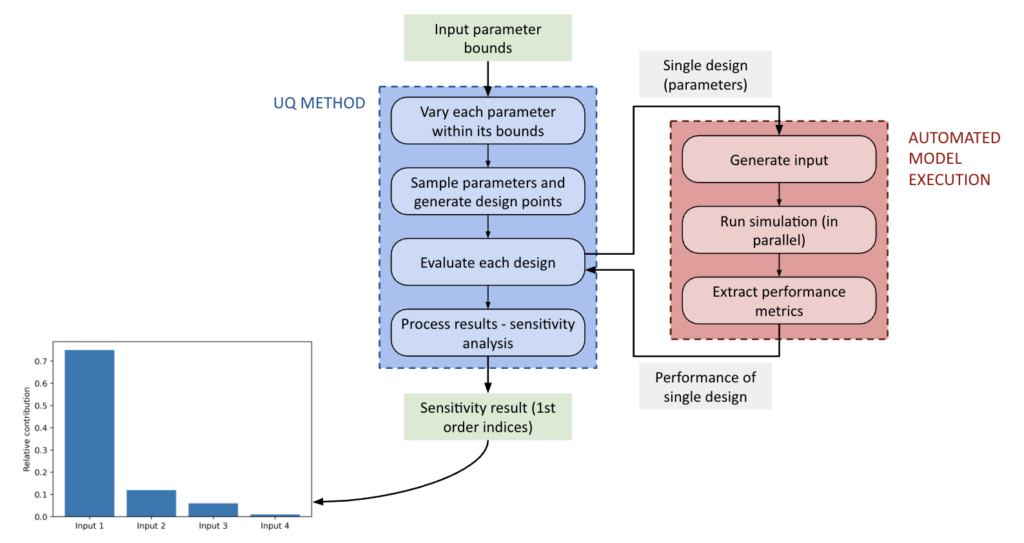
Our approach combines parametrised simulation models with automated, large-scale analysis. Key input parameters are identified and assigned realistic ranges based on engineering knowledge and experimental data. These ranges reflect how the system is likely to vary during operation. Automated pipelines are then used to generate, execute and extract results from thousands of simulation cases without manual interaction. This allows large numbers of parameter combinations to be explore efficiently which would not be practical using manual simulation workflows. Running this volume of simulations requires significant computational resources. Our onsite high performance computing capability allows thousands of simulations to run in parallel, making it possible to apply UQ to complex engineering problems.
As shown in the workflow below, generating and analysing large numbers of design points is essential to understanding how uncertainty propagates through a system.
Understanding uncertainty in fusion systems with UKAEA
We have been working with the UK Atomic Energy Authority (UKAEA) to apply uncertainty quantification to tritium breeder blanket designs within the LIBRTI project. These components are critical to fusion reactors, as they produce the tritium required to sustain the reaction. Their performance depends on a wide range of parameters, including material properties, geometry and transport behaviour, many of which carry uncertainty.
Parameterised simulation models were used to explore variability across these parameters. Thousands of simulations were then executed on our high performance compute system to assess their impact on tritium production and extraction efficiency. Hundreds of parameters were varied as part of the analysis. Most were found to have minimal influence on predicted performance and could therefore be deprioritised in future investigations. The analysis also identified a smaller number of key drivers that strongly influence tritium production and extraction rates. These parameters can now be investigated further by UKAEA to better understand their impact on reactor performance and fuel generation.
'What UQ gives us is clarity. Out of hundreds of parameters, we can identify the few that genuinely drive performance, and just as importantly, the many that don't.' Isaac Santos - Research Engineer, CFMS
Understanding uncertainty in energy systems
We have also applied similar approaches in energy systems through our work with National Gas Transmission.
Unaccounted for Gas (UAG) is the cumulative effect of small metering errors across thousands of meters within the National Transmission System. While each individual error may be small, together they can affect system balancing, cost allocation and regulatory reporting.
Due to the scale and complexity of the network, isolating sources of error using traditional statistical methods is challenging. By combining simulation with analysis techniques, expected system behaviour, such as gas flow and system balance, can be compared with measured data to identify discrepancies across the network. UQ helps quantify how uncertainty in measurements and data quality affects predicted system behaviour. This supports the easier identification and localisation of error sources such as metering inaccuracies and data inconsistencies.
In the longer term, this type of predictive approach has the potential to support targeted investigations, proactive maintenance and improved metering accuracy, helping reduce UAG and its associated operational, financial and regulatory impacts.
A more complete view of system performance
Uncertainty is an inherent part of engineering, but it does not mean we can't understand it.
Incorporating UQ into simulation workflows moves analysis beyond single-point predictions and provides a clearer picture of how systems behave under real-world conditions. This supports more confident decisions, more targeted design improvements and a stronger understanding of what drives system performance.
This approach sits alongside the modelling and simulation work we carry out every day. By combining parameterised models, advanced analysis techniques and the computational power of our onsite high-performance computing infrastructure, complex systems can be explored in greater depth to generate meaningful insight.
If you would like to learn more about how we apply uncertainty quantification or discuss how it could support your work, please get in touch.