

Advanced Manufacturing Method Development
Challenge
Advanced manufacturing processes, such as additive manufacturing, can allow for large parts with complex geometries to be created quickly, with little material waste. These processes involve a range of multi-scale and multi-physics phenomena, controlled by several process parameters, that ultimately affect the quality of the printed part; for example, through the formation of defects or post-print thermal distortion that can render the parts unusable.
These are the challenges that a tier one aerospace company is facing while advancing and productionalising the Laser Metal Deposition by wire process. Manufactured products using this technique can be complex 3D geometries, up to metres in scale, cost upwards of £100k to produce and take several weeks to build.
Process optimisation is essential to consistently achieve the high-quality parts required for the industrialisation of these technologies. Performing experimental trials to achieve this is time, cost and resource intensive. As a result, simulations of the robotics systems and multi-physics processes can be used to improve understanding of the process, reduce the expensive of experimental trials and get closer to right-first-time builds. However, commercial off-the-shelf software tools are often not capable of modelling all the complex multi-physics at the required scales and in the specified timeframes.
Solution
We have developed a collection of bespoke models and multiphysics simulations for different parts of the manufacturing process. This includes:
- A digital platform for capturing, storing and analysing metric data from the build chamber using an Industrial Internet of Things (IIoT) system to understand trends or predict maintenance requirements of components
- Dynamic and kinematic models of the multi-arm robotics system used to deposited material to understand potential variability in the position of the deposited tracks
- Computer vision algorithms to analyse camera outputs of the melt pool and determine whether anomalies or defects of the melt pool exist
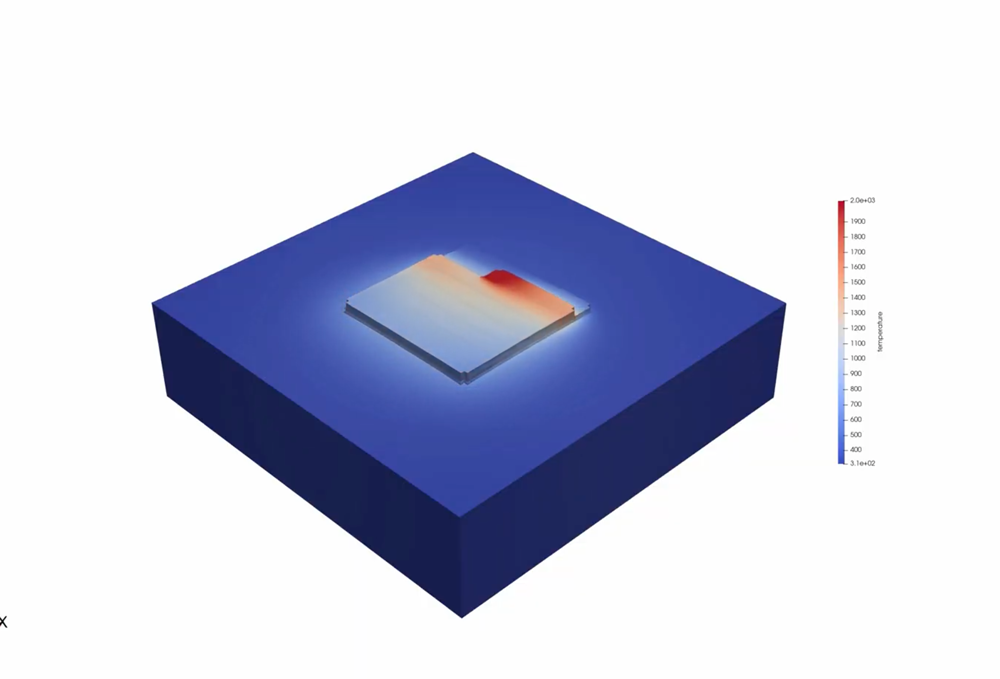
- Multi-scale thermomechanical distortion simulation to predict the post-print thermal distortion of manufactured parts
- Large-scale ultrasonic models for the NDT inspection process to support the qualification of inspection configurations by demonstrating whether defects can be accurately and consistently identified.
Using open-source frameworks that can natively scale to run on high performance compute infrastructure enables these simulations to be used in design space exploration to better understand and quantify the impact of experimental uncertainty on parts with large and complex geometries.
Impact
The melt pool anomaly detection algorithm was integrated within the build system to enable engineers to adjust the process when defects are likely form, improving build quality.
The multi-scale thermomechanical distortion simulation tool went through a Technology Readiness Level (TRL) gate where the results were validated against experimental values from printed physical components. Simulations can execute in the order of hours, taking significantly less time than alternative tools which can take in the order of days or weeks to complete. Engineers can cheaply undertake process optimisation studies to determine, for example, what the most appropriate deposition strategy is, or what substrate thickness to use to minimise waste.
The NDT simulation was used to identify which setups should be used to detect different kinds of defects in different areas of manufactured parts, helping to define the requirements for future automated inspection systems.
Overall, these tools can be used earlier in the build process to inform the deposition strategy that should be applied for each build. Engineers have greater physical insight into the process, allowing them to optimise process parameters to improve build quality, get closer to right-first-time builds and save time and cost.