


Composite simulations to prove novel manufacturing techniques
Challenge
Carbon fibre composite parts are widely used across a range of industries, due to the typically high strength-to-weight ratio of the material. In particular, the aerospace industry is seeking to manufacture increasingly large and complex parts more quickly to meet the future global demand for highly efficient aircraft. However, these requirements come with a host of challenges.
The manufacturing techniques used to produce such parts are highly sensitive to small variations and can be difficult to control precisely. The material itself can be prone to defects which are difficult to detect, whilst part tolerances are extremely stringent due to the safety-critical nature of the industry. This results in high rates of rejected parts due to non-conformance which is both costly and wasteful.
The ability to predict and interrogate part performance, manufacturability and the knock-on effects of small defects could enable the design of parts and processes to be efficient, compliant and reliable from the ground up.
Solution
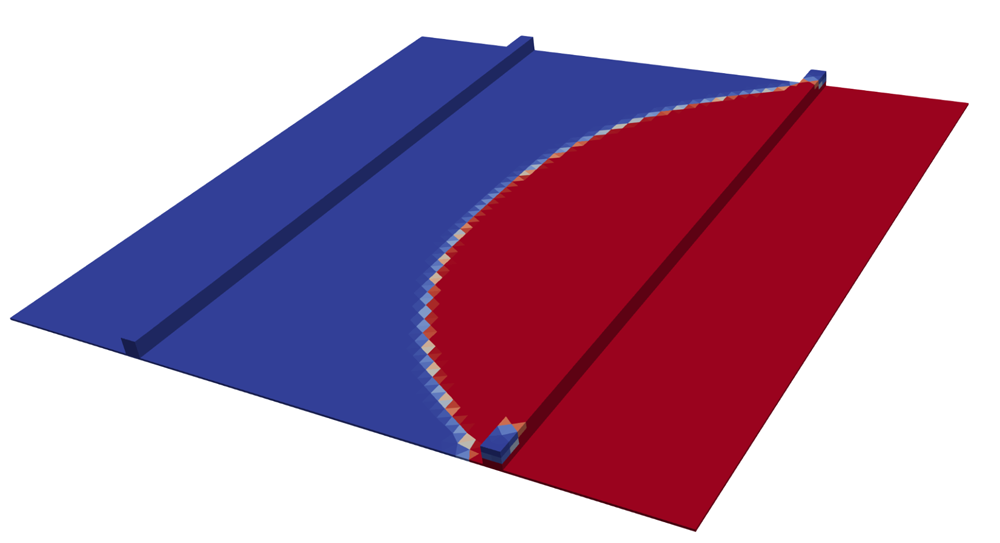
Working with aerospace manufacturing partners across the ATI, we have developed a range of simulation techniques associated with the manufacture and performance of composite parts. These range from microscopic scale resin flow simulation to understand variations in low-level material properties, to part-scale simulated structural testing.
Our suite of composite simulations are designed to be modular, scale effectively to utilise high-performance compute and can be automated across pre-processing, execution and post-processing phases of manufacturing. The result is the ability to capture the effects of uncertainty through large-scale automation of simulation pipelines which couple appropriate modules, identify critical parameters and optimise design parameters for parts and processes accordingly.
Impact
Combining physics-based process simulations with automation and optimisation demonstrated the possibility of discovering counterintuitive but performance enhancing design decisions using the tools and methodology developed at CFMS.
Future development aims to integrate this approach with industry partners to inform the design of future manufacturing facilities and enable the use of simulation at scale with design and manufacturing processes.