

Multiphysics simulation to understand complex real-world systems
Challenge
Physical modelling is a powerful and increasingly essential tool in the attempt to understand complex real-world systems, providing tangible benefits across various sectors including aerospace, energy, advanced manufacturing and national infrastructure.
Many of these complex systems are driven by multiple disparate physical processes which are often very tightly coupled. There is a need for a robust Multiphysics modelling approach, as focusing on any single physical process will inevitably provide an incomplete description of the system.
A significant challenge to overcome is how to integrate multiple processes such as heat transfer, structural mechanics or fluid flow into a single framework. If different types of numerical methods are used to model each of these phenomena, coupling the interactions between them can introduce significant difficulty.
Solutions
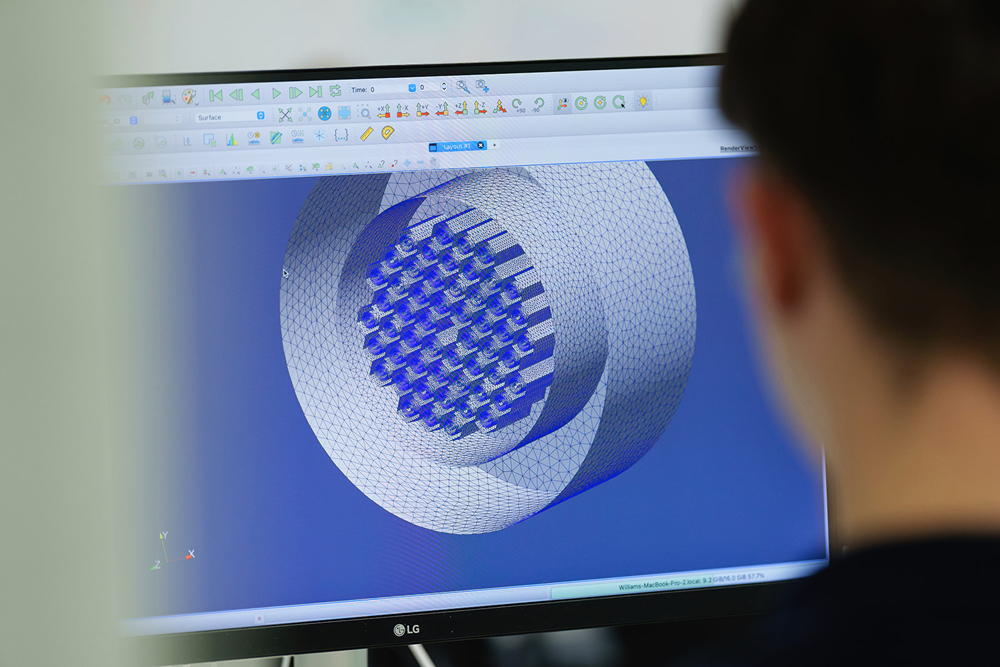
We have used multiphysics simulation frameworks such as MOOSE and MFEM to meet this challenge. These frameworks are flexible, modular and highly scalable to large problems as they support HPC deployment. Multiple physical phenomena can be modelled and allows for interactions between them to be implemented by coupling systems together.
This has been used in the modelling of a tritium breeder blankets to reduce uncertainty and improve the performance of nuclear fusion reactors. Individual models were developed for both tritium transport and neutronics using MOOSE, with these being coupled together to gain a more holistic view of the factors that impact the performance of the breeder blanket.
As MOOSE supports parallelisation natively, these models can be deployed on our HPC system to rapidly generate large quantities of results. This is essential for techniques such as uncertainty quantification and sensitivity analysis, where thousands of individual realisations are often required.
Impact
Multiphysics modelling allows for complex processes across multiple domains to be simulated, increasing model accuracy and providing a deeper understanding of complicated physical interactions. The parameterisation of simulation tools allows for the exploration of different operating conditions which is often infeasible to achieve using physical testing due to scale or safety constraints.
Virtual testing through multiphysics modelling offers the potential for more rapid analysis of variability within systems to inform improvements in the design process; this carries significant time and cost savings, enabling more informed decisions to be made more quickly.