


Non-Destructive Testing Development for Safety Critical Components
Challenge
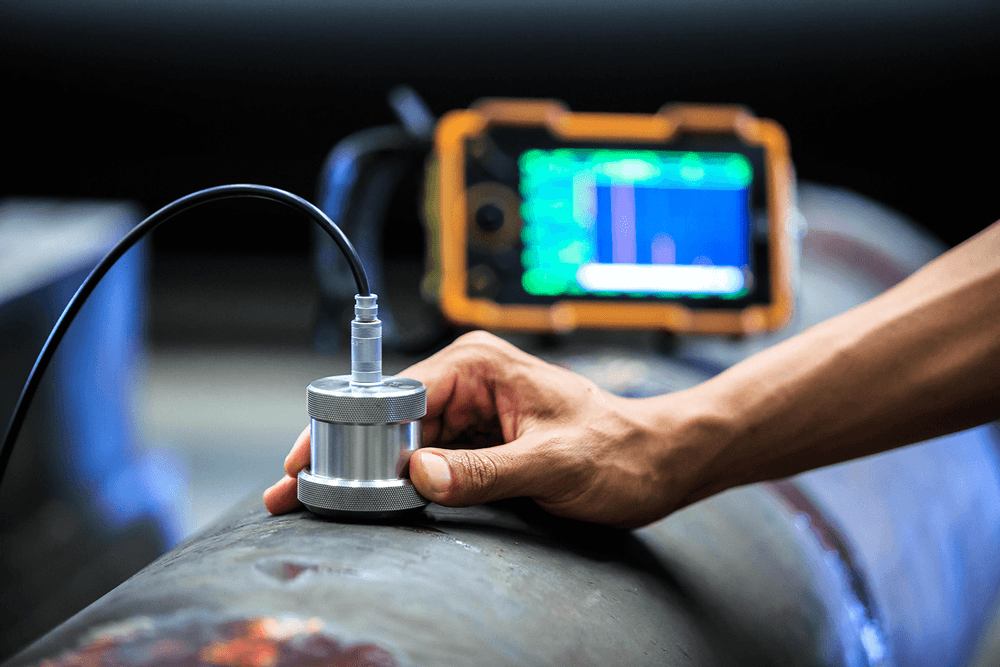
Composite materials are increasingly used in aerospace manufacturing. While they offer clear performance benefits, they also introduce greater complexity for non-destructive testing inspections.
Variations in geometry, thickness and defect type make inspections harder to design, validate and qualify. Traditional ultrasonic NDT development relies heavily on physical testing. This needs large numbers of test samples and sensor configurations to be manufacturered and assessed. This approach is time-consuming and costly. In many cases, it slows down the introduction of new inspection techniques and delays the commercialisation of new products.
Key outcomes to be achieved were:
- Reduce the cost and time associated with inspection development and qualification
- Replace significant volumes of experimental testing with validated simulation
- Improve defect detectability and inspection robustness
- Identify optimal inspection and sensor configurations in a structured way
Solution
We applied a model-based engineering approach to the inspection development process. Inspection performance was explored digitally using advanced simulation, optimisation and sensitivity analysis.
Detailed mathematical models were used to show how ultrasonic waves move through composite materials, making it possible to predict inspection results in various scenarios without the need for lengthy physical testing. The models were validated against experimental measurements from test pieces with known defects, ensuring simulations accurately represented real-world behaviour.
We applied optimisation and sensitivity analysis to understand which parameters had the greatest influence on inspection performance. Sensitivity analysis enabled effort to be focused on parameters that materially affect inspection results, rather than exploring all variables equally. This highlighted the parameters with the greatest impact on results, enabling more focus on where it matters most, saving time, computational power and unnecessary complexity.
Using high performance compute, we evaluated large numbers of inspection scenarios at scale. Around 500 composite plate variants were simulated to assess the effect of thickness variation on defect imaging. Around 60,000 sensor configurations were analysed to identify an optimal arrangement capable of detecting array faults reliably.
The modelling also examined embedded sensor designs. Simulation showed that embedding sensors provided no inspection benefit, avoiding the need to manufacture complex, expensive components unnecessarily.
Impact
By replacing many experimental trials with validated simulation, the project delivered clear benefits.
Inspection design and validation costs were significantly reduced.
- More than 500 composite test plates did not need to be manufactured.
- Optimal sensor configurations were identified more efficiently and with greater confidence.
- A broader range of defect scenarios could be explored than would be practical using physical testing alone.
With composite plates costing between £2,000 and £9,000 each, the simulation-led approach resulted in savings of over £2 million in manufacturing costs.
The approach also increased confidence in inspection performance by enabling extensive testing across realistic manufacturing variability within a shorter timeframe.
The project showed how model-based optimisation can support more efficient and robust NDT inspection development. By reducing dependence on physical prototypes and enabling systematic exploration of inspection behaviour, CFMS helped accelerate development while lowering cost and risk.