

Path Planning Robotic Arms in Manufacturing
Challenge
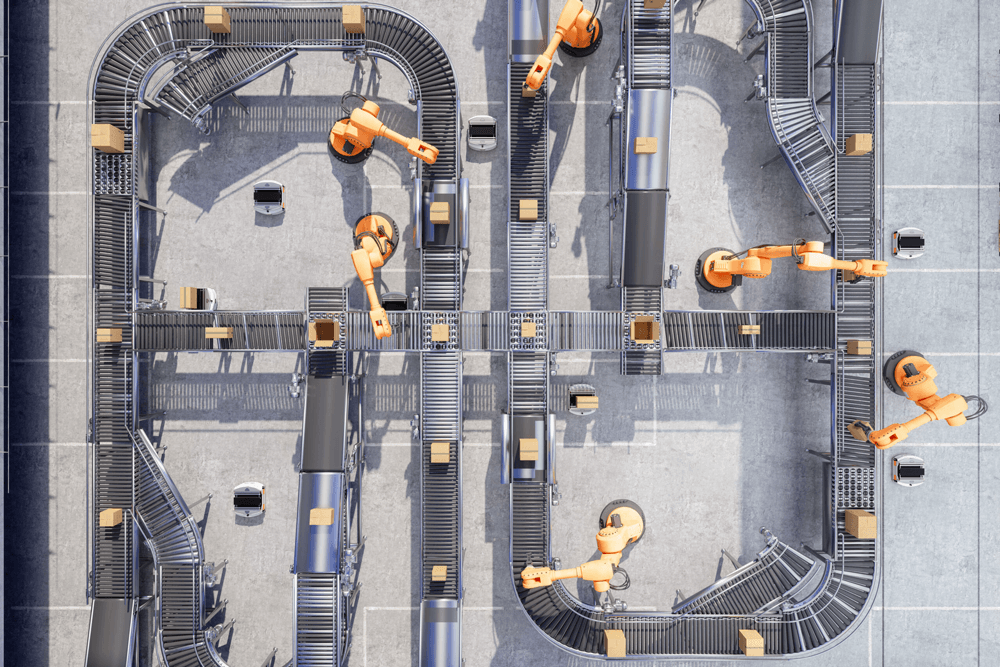
Robotic arms play a crucial role in many manufacturing processes by automating a wide range of manual tasks. Using these robotic arms requires accurate planning of the path they will follow when operating. This planning process is subject to various goals and constraints, such as trying to minimise the total path execution time whilst not colliding with obstacles or ensuring accuracy and repeatability of the movements.
Typically, there are a range of viable paths that would be acceptable, but with varying trade-offs. Understanding all these factors and being able to produce robust, highly performant plans is a significant challenge for manufacturing engineers.
Solution
We have developed full dynamic models of robot arm movements, using the physical properties of the robotic to predicts its evolution in time. This provides highly accurate estimates of how the robot arm will perform in the real world. Models are fully parameterised, enabling the properties of the simulation to be quickly changed and different possible paths tested. This flexibility enables rapid optimisation and uncertainty quantification, providing insight into the best configuration of the system and the likely tolerances on the movements.
In additive manufacturing, this is particularly important as subtle variations in the followed path will result in misalignment of printed tracks, and possibly undesirable performance in the resulting part.
Impact
Simulation allows planned robot paths to be quickly validated and visualised, enabling engineers to check before committing to physical builds. This improves the efficiency of manufacturing processes, reducing the likelihood of committing to an incorrect build process.
It also enables engineers to rapidly evaluate scenarios, allow them to test different plans and configurations, and optimise the manufacturing process during the design process. Overall, this accelerates and improves the robustness of the design.